2026 is starting under a cloud of uncertainty. International tensions persist, economic instability remains, cyber threats and geopolitical risks continue to grow, and technological dependency still weighs heavily on organizations. Digital technology, once seen as a driver of innovation and positive projection, now sometimes feels trapped between regulatory constraints, commercial pressure, and the absence of a clear long-term public strategy.
Yet there are good reasons to remain optimistic. The French and European digital ecosystem is showing remarkable vitality, as clearly demonstrated by OSXP 2025. Software publishers are holding their course, innovating, and building solid, sustainable solutions designed for real-world use. BlueMind did not wait for the broader context to deteriorate before committing fully to this dynamic. For years, our direction has been clear and unchanged: deliver a sovereign, reliable, and modern collaborative messaging platform that reconciles IT requirements with user expectations, and finally makes it possible to move away from hegemonic solutions.
What if, at the start of this year, you chose a forward-looking resolution for your organization, powered by the progress of BlueMind v5? A messaging platform that restores control and peace of mind, while ensuring the continuity of everyday user workflows.
The BlueMind v5 revolution
BlueMind 5.0 marked a turning point in the collaborative messaging market. It delivered a major technological and functional breakthrough, guided by a single priority: meeting user needs without compromising sovereignty.
This step forward was built on three decisive pillars. First, native Outlook compatibility, a global exclusivity and the number-one expectation of the market. Second, the introduction of a brand-new webmail, modern and fully aligned with current standards. Third, native support for object storage.
All of this was made possible by a new messaging core that replaced the historic Cyrus IMAP engine, opening the door to deep and lasting innovation.
So… are we migrating now?
With the main functional requirements finally addressed, it would be tempting to think that leaving Microsoft behind has become a mere formality.
What is often overlooked is that email remains the most widely used and most critical application within organizations. It sits at the very heart of daily operations and deeply ingrained user habits. Any change, even a minor deviation, can generate disruption, confusion, or broken business processes, ultimately blocking the entire migration project.
In other words, offering webmail, calendars, Outlook connectivity, and mobile access is not enough to migrate an organization away from Microsoft. Success requires matching, as closely as possible, the countless features and behavioral patterns users rely on in Microsoft Outlook with Exchange or Microsoft 365.
From BlueMind 5.0 to 5.4: serving real users
As is often the case, the devil is in the functional details.
BlueMind has gradually integrated many long-awaited capabilities such as individual folder sharing, scheduled sending, conversation view, EML import, and one-click download of all attachments. Countless usability and display improvements have strengthened comfort and productivity, from multiple quota display levels to copy-paste of addresses and address lists, advanced sorting and search options, conversation ordering, simplified filter management with conditional rules, and much more.
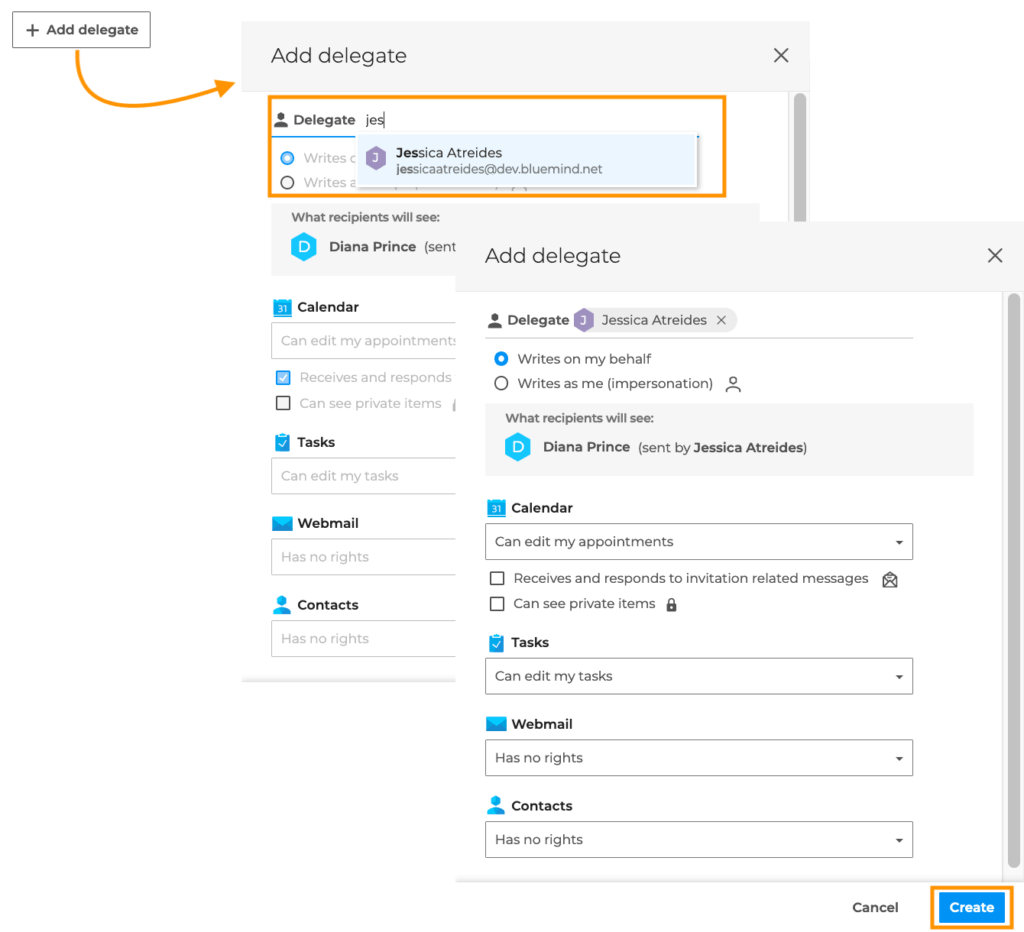
Delegation management was introduced with behavior that faithfully mirrors Outlook, a decisive requirement for executive assistants and administrative teams. Users can now send messages “on behalf of” or “as” another person, and manage invitations or delegated calendars with a high level of precision.
A new desktop client also allows BlueMind to be used independently of the browser while directly accessing the system’s certificate store. This strengthens integration into the work environment and removes technical friction for users.
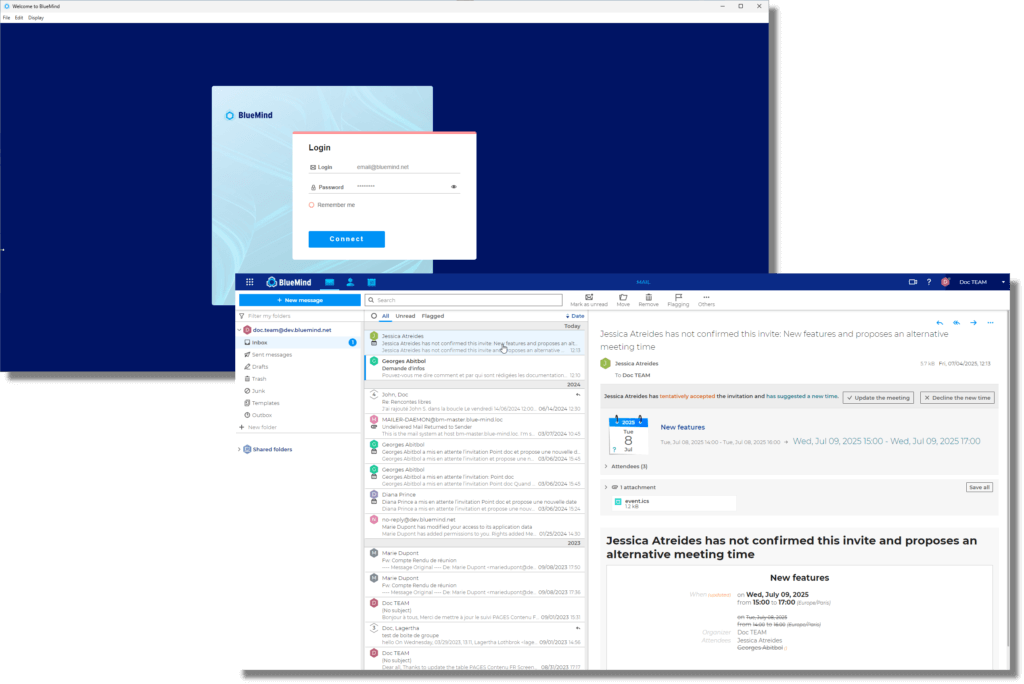
Native Outlook compatibility continued to progress in the same direction. Delegation handling and collaborative scheduling now work seamlessly between Outlook and BlueMind, and videoconferencing can be added directly from Outlook.
The calendar has also become more intelligent and more readable. Counter-proposals for recurring meetings are handled more effectively, resources can automatically accept reservations in series, and meeting history makes it possible to track changes over time. Invitations can be forwarded to include additional participants, and availability views now benefit from a new Outlook-style display.
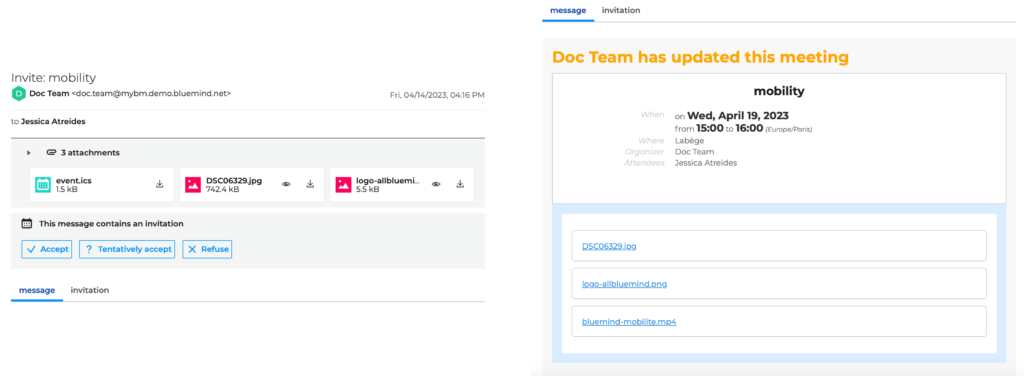
On the architecture and administration side, SSO management via OpenID is now available. A two-level recycle bin is accessible to all users from both Outlook and the web interface. The backup system, including individual item restoration, has been fully redesigned and significantly optimized. The overall architecture continues to evolve through ongoing performance and reliability improvements.
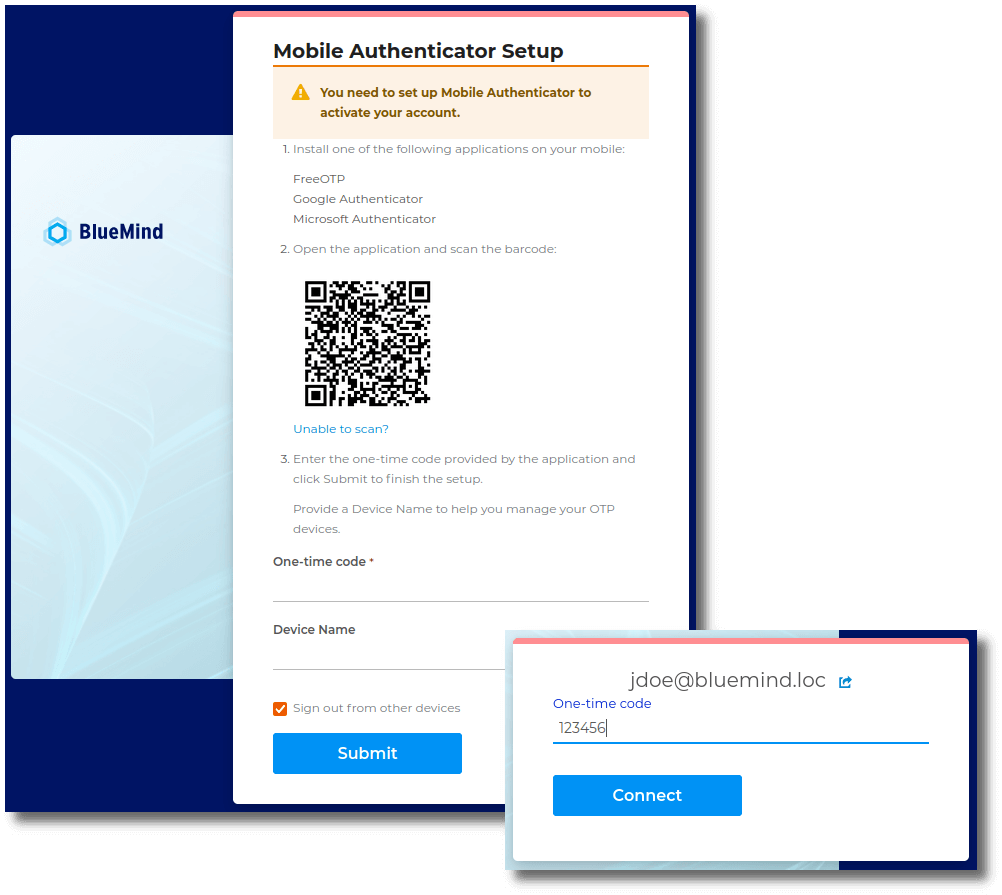
Security remains a central concern in a context where cyberattacks increasingly exploit email as an entry point. Multi-factor authentication is available, along with support for S/MIME encryption and message signing. Since version 5.3, a warning system alerts users to suspicious recipients or potentially malicious links, particularly when the actual destination differs from the displayed text. One thing remains true, however: no security feature replaces proper preparation.
BlueMind 5.5: reaching the peak of usability
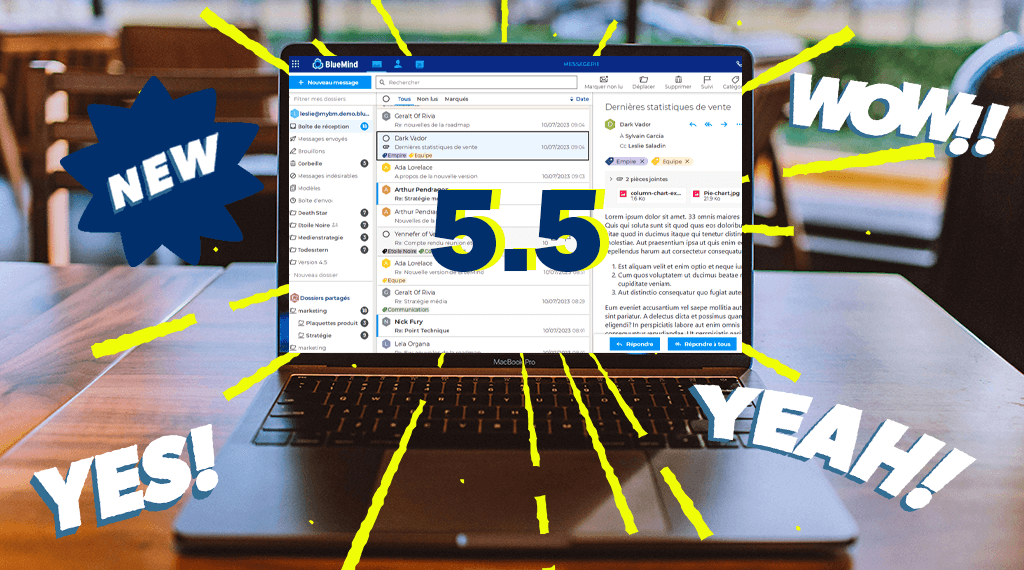
Released in January 2026, version 5.5 represents another major qualitative leap in terms of user experience and everyday usage. Exchange-style shared mailboxes, unified categories between Outlook and webmail, mail tips, message prioritization, group delegations, and many other enhancements further raise the bar.
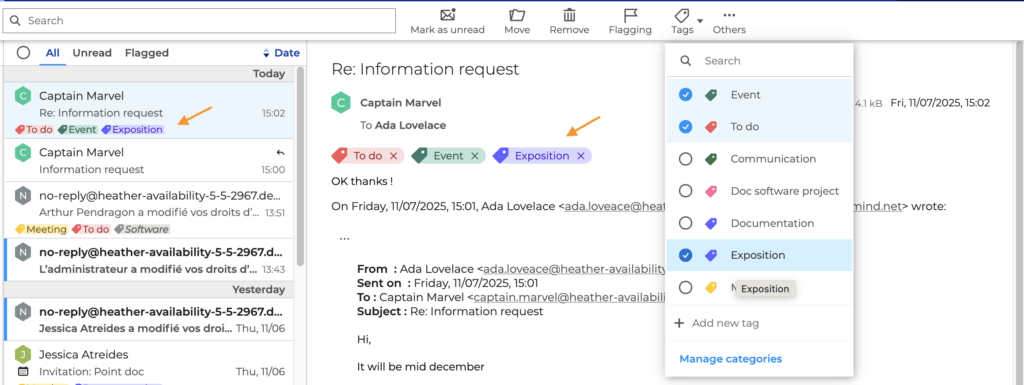
Categories synchronized between Outlook and the web client are now available in webmail. They allow users to tag messages, assign colors, themes, projects, or actions, and create them on the fly to boost productivity. Messages can also be marked as “Important” to clearly signal when immediate attention is required.
Shared mailboxes evolve into true Exchange-style shared mailboxes. BlueMind is the first and only alternative solution to support Exchange shared mailboxes in their full functional scope. These are real mailboxes with their own calendars, address books, categories, and filters, offering teams a structured shared workspace, whether accessed from Outlook or webmail.
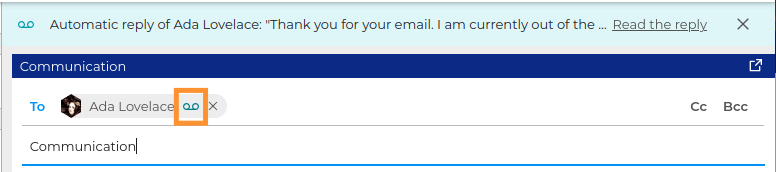
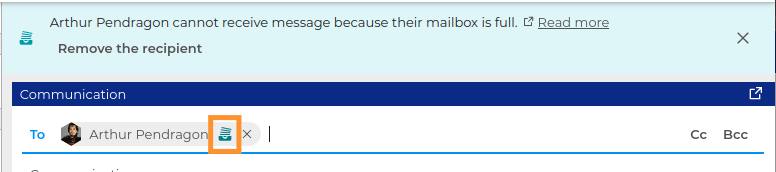
Mail Tips are now available as well. When composing a message, BlueMind displays a small notification in Outlook and webmail if the recipient has an out-of-office message enabled or a full mailbox.
Message prioritization makes it possible to highlight important communications more clearly.

This cycle of webmail improvements aims to deliver a level of comfort comparable to a desktop client. The compose window adapts to individual preferences, default fonts and sizes can be configured, folder and message panes are resizable, recipients can be rearranged via drag and drop, and shared mailbox quotas are now visible to users.
Identity management also continues to evolve, with more intuitive display name customization, strengthened API keys, and more flexible multi-factor authentication options.
Taken as a whole, this release is firmly anchored in everyday usage and designed to support teams over the long term.
Conclusion: BlueMind v5, your strongest ally on the path to sovereignty
There are no longer any valid reasons not to migrate. The importance of sovereignty, strategic autonomy, and both digital and financial independence is now widely understood. The challenge is no longer about proclaiming these values, but about turning them into reality.
Delivering a messaging platform that truly enables organizations to leave the Microsoft ecosystem is not a slogan. It is the result of years of sustained effort to implement hundreds of features and deeply rooted user behaviors, without which migration simply cannot succeed.
After nearly fifteen years of work, BlueMind demonstrates that it is possible to build a sovereign messaging environment that combines performance, security, and user comfort at the highest level.