Digital sovereignty is everywhere in the conversation, yet in practice the big shift hasn’t happened. This gap is worth unpacking.
Digital sovereignty now sits at the heart of political speeches, industry events, and expert commentary. People talk about technological independence, data security, and control over infrastructure. On the ground, though, progress is slow. Public and private organizations still rely heavily on non-European technologies, even in sensitive contexts. The gap between what’s said and what actually happens is hard to ignore. It isn’t simply a matter of ignorance or lack of effort. Email makes that clear.
Ideology, solutions… and the reality on the ground
Most public discussions revolve around solutions. New platforms are showcased, feature lists compared, sovereign initiatives highlighted. From a distance, everything seems to be in place. Yet despite the stakes and the availability of alternatives, large-scale adoption still isn’t happening.
It’s easy to point fingers at IT departments and assume they’re not trying hard enough. The reality is more grounded. Decisions are rarely ideological. They’re shaped by day-to-day operations. European alternatives do exist, but if they don’t fit smoothly into existing workflows, they won’t be chosen. That’s where things actually turn.
The Lecko–Ipsos 2026 study puts numbers on it: only 12% of public sector users and 16% in the private sector consider sovereignty a key factor when choosing collaborative tools, while more than 60% prioritize solutions that match how they work.
This changes how solutions are evaluated. When a tool introduces new capabilities, it’s judged on the value it brings, how easy it is to use, and how well it integrates into what’s already in place. When it replaces something that already works—like Microsoft email—it’s judged on continuity. Users expect to keep working the same way, without friction, without slowing down, without having to relearn everything.
Four walls and a roof
Picture a house you’ve grown comfortable in. Everything is set up the way you like it. Daily routines run smoothly.
You have a well-designed kitchen, several bedrooms, a terrace, a garage that fits both cars. It’s more than a place to live—it’s the center of your daily life. You’ve built habits around it. You come in through the garage, unload what you need for work, close all the shutters with a single switch, hang laundry out in the sun.
Now imagine the cost rises by 15% every year, and the area becomes uncertain. You start considering a move. Developers offer you “sovereign” alternatives. On paper, they look similar: same number of rooms, a garden, a garage, automated blinds.
But once you look closer, things start to shift. The garage no longer connects directly to the house. The blinds are automated but not centralized. The kitchen layout feels off. The bathroom sits far from where it should be. Lighting works in ways that don’t match your habits. The garage fits two cars, but only one behind the other.

The deeper you look, the more small frictions appear. Individually they seem minor. Together they change everything. Moving would mean reworking your daily life and your professional setup. Your family is already busy. No one wants to take that on.
You decide not to move.
The developers don’t understand. From their perspective, everything checks out. They assume the issue lies with you—that you’re unwilling to adapt.
But a house is more than four walls and a roof. It’s a place you live in. Email works the same way.
The reality wall of email
Email sits at the core of daily work. It structures communication, organizes time, and supports business processes. For years, Exchange and Outlook have been the default in many organizations. Everything works. Except costs keep rising, and geopolitical risks are becoming harder to ignore. You start looking at alternatives. At first glance, they seem comparable: sending emails, scheduling meetings, sharing attachments.
Then you look closer. Many day-to-day workflows—sometimes business-critical—are built around advanced Outlook features that alternatives don’t fully replicate. Just like with the house, you know users won’t follow if their way of working is disrupted. They’re already busy. They don’t have time to relearn tools that currently do the job.
This gap between high-level comparisons and real-world usage is what ultimately drives decisions. It’s also what gets overlooked in most sovereignty discussions.
Adapting to users, not the other way around
Changing an email system means changing a critical layer of the organization. Years of usage, integrations, and processes depend on it. IT teams tend to choose solutions that preserve continuity. This isn’t about rejecting sovereignty. It’s about managing risk while keeping the organization running. The idea that users will adapt by changing their habits to fit a new solution doesn’t hold up in practice. Work constraints leave little room for that.
Things move in the opposite direction. The solution has to fit existing usage first. Only then can change happen gradually. From a user perspective, moving away from Microsoft email means maintaining continuity—changing, without really changing. This comes down to two expectations: being able to keep using Outlook and its key features, at least during the transition, and ensuring a migration that preserves user context and avoids friction.
Outlook support
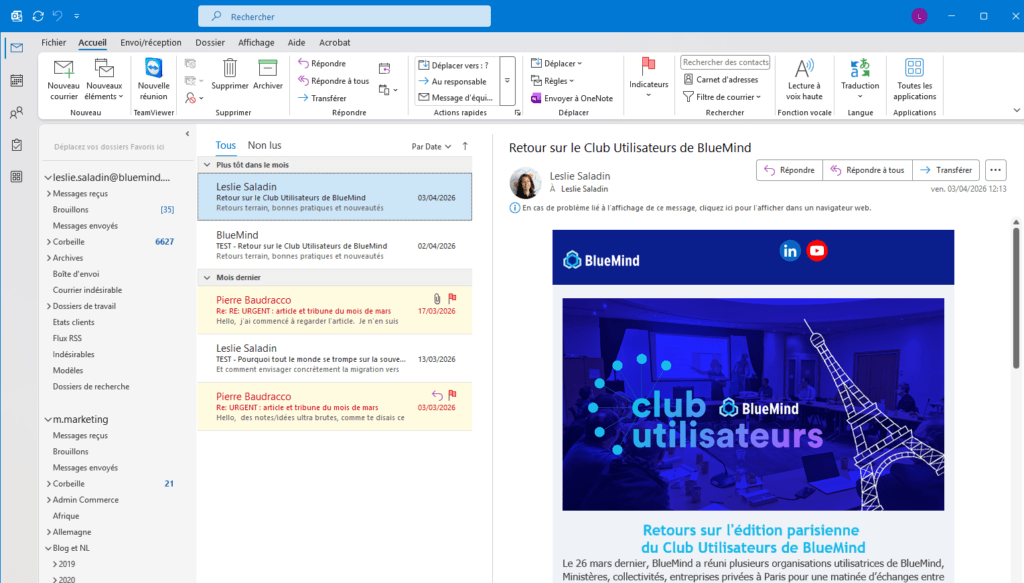
For most users, email simply means Outlook. They don’t think in terms of servers, protocols, or formats. They expect it to work, like electricity when you flip a switch. Over time, Outlook has become more than an interface. It supports complex workflows that are now part of everyday operations: delegation models, fully featured shared mailboxes, advanced scheduling interactions, contextual information before sending emails.
These are not optional features. They shape how work gets done. Removing them changes the organization itself. Maintaining this environment is essential for any transition to be accepted.
Frictionless migration
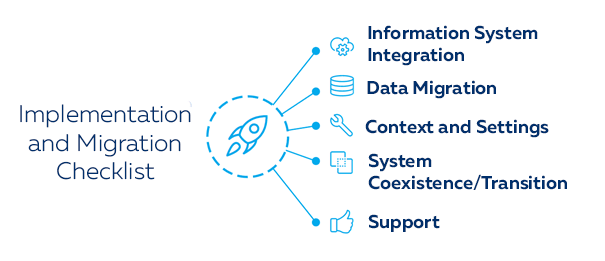
Finding the right solution is only part of the journey. Migration is a challenge in its own right. An email system is not just a set of files. Each user has built an environment made of data, rules, permissions, and preferences. All of this needs to be preserved.
The complexity is significant: large volumes of data, universal usage across the organization, and zero tolerance for downtime. During the transition, old and new systems often need to run side by side. Emails must keep flowing. Calendars must remain reliable. Work cannot slow down. Bringing users along requires a proven migration approach that can handle data, manage coexistence, and preserve user context throughout the process.
The importance of technological mastery
Supporting Outlook in Exchange mode, delivering equivalent functionality across interfaces, and handling full-scale migrations require deep technical expertise. This isn’t just about ticking feature boxes. It’s about recreating an environment that feels familiar from day one. That level of control is what makes adoption possible—and what ultimately makes sovereignty achievable.
From vendor perspective to user reality
Sovereignty debates often bring together people who already agree—advocates and solution providers who struggle to understand why users don’t follow. Change doesn’t happen by decree. In email, it grows out of existing practices, habits, and tools that shape everyday work.
Pushing sovereignty harder or asking users to change how they work doesn’t lead anywhere. What matters is shifting perspective—starting from the user, understanding real usage, and building solutions that fit. Supporting Outlook and its advanced features is demanding work, but it opens the door. From there, organizations can gradually diversify how they access email—webmail, mobile, alternative clients—and move at their own pace.
Digital sovereignty doesn’t come from declarations. It takes shape in day-to-day operations, in tools that people can adopt without disruption. That’s where it becomes real—and where solutions like BlueMind are making it happen.